If you work in heavy manufacturing or industrial machining, you’ve likely encountered the T Structure HMC (Horizontal Machining Center) at some point. These machines are workhorses for high-volume, precision part production—think automotive engine blocks, aerospace turbine components, or heavy equipment structural parts. As a supplier of T Structure HMCs, one of the most frequent questions I get from new and repeat customers alike is also one of the most critical: “Do these machines need a special foundation?” T Structure Hmc Machine
It’s a question that doesn’t have a one-size-fits-all answer, but getting it right is the difference between a machine that runs for 10+ years with consistent precision and one that causes costly downtime, part defects, or even structural damage to your facility. Over the past 12 years selling, installing, and supporting T Structure HMCs, I’ve seen first-hand how a misaligned foundation can derail a project—and how a properly designed one can make a machine perform far beyond its rated capabilities. Let’s break this down, so you don’t have to learn the hard way.
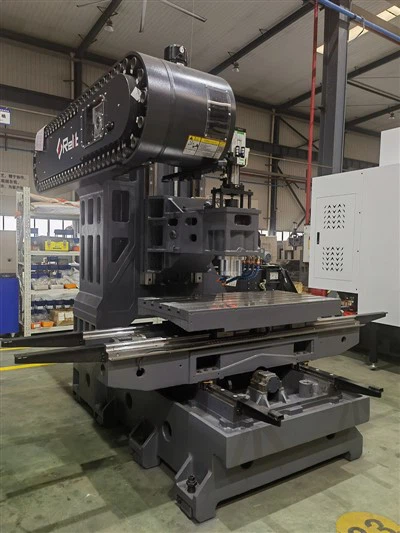
First, let’s clarify what a T Structure HMC is, because that core design is the root of its foundation requirements. Unlike a vertical machining center (VMC) where the spindle moves up and down over a fixed table, a T Structure HMC features a horizontal spindle axis, and its “T” shaped frame distributes cutting forces across a rigid base. The T design gets its name from the cross-shaped arrangement of the column (which holds the spindle), the main base, and the table that holds workpieces. This design is optimized for heavy cuts, chip evacuation, and multi-sided machining, which is why it’s the go-to for large, high-force applications. But that rigidity comes with very specific load and stability demands.
Now, to the heart of the question: Yes, T Structure HMCs do require a special foundation—not because they’re fragile, but because they’re extremely precise and generate massive dynamic forces during operation. Let’s start with the loads a T Structure HMC exerts. A mid-sized T Structure HMC (say, 15,000 kg / 33,000 lbs capacity) can exert up to 20,000 lbs of force during a heavy steel cut, with constant vibration, torque, and cyclic loading as it moves its axis and engages workpieces. Unlike light-duty equipment that can sit on a basic concrete slab, these forces will cause a standard, un-reinforced slab to shift, settle, or flex over time. Even a tiny shift (just 0.01 mm) can throw spindle alignment off, leading to 10% or more of your parts being out of spec.
I once had a customer who skipped a custom foundation to save $12,000, opting instead to pour a standard 6-inch concrete slab over existing floor slab. They installed a 12-axis T Structure HMC for aerospace landing gear components. Within three months, they started getting 15% scrapped parts because the spindle’s alignment drifted 0.02 mm. The root cause? The un-reinforced slab couldn’t handle the 24/7 cyclic loading from the machine. The machine’s base was pulling and pushing the slab, causing micro-settling that added up to precision loss. They ended up having to pull the machine, break out the old slab, pour a 12-inch reinforced foundation with vibration damping, and lost three weeks of production. That “savings” turned into a $75,000 cost in downtime and repairs.
So what makes a foundation “special” for T Structure HMCs? Let’s break down the key requirements, tailored to the design of these machines.
First, foundation mass and rigidity. T Structure HMCs rely on the machine’s base to act as an extension of the foundation. That means the foundation needs to be at least 1.5 to 2 times the machine’s total weight, depending on the HMC’s capacity. A 10,000 kg T Structure HMC needs a foundation mass of 15,000 to 20,000 kg. For heavy-duty models (20,000 kg+), that number jumps to 2.5 times the machine’s weight. The concrete itself needs to be high-strength—minimum 4,000 PSI, often 5,000 PSI for high-load environments. We also specify rebar mesh or rebar grids at the top and bottom of the slab to prevent cracking and flexing under dynamic loads.
Second, vibration isolation and damping. This is non-negotiable for T Structure HMCs, because their high-speed spindle movements and heavy cuts generate resonant vibration that can propagate through the floor and into adjacent equipment (like another HMC, a coordinate measuring machine, or even a precision grinding machine). There are two approaches here: active and passive isolation. Active isolation systems (air bags, hydraulic dampers) are best for facilities that already have floor vibration from cranes, forklifts, or other equipment. Passive isolation (vibration-damping concrete mix, rubber or neoprene pads under the foundation) works for low-vibration facilities. But for most T Structure HMC installations, we recommend a combination: a reinforced concrete base with a 2-inch layer of vibration-damping aggregate under the slab to absorb high-frequency vibrations. I’ve seen facilities skip the isolation layer and have two adjacent HMCs drift 0.03 mm each just from cross-vibration, leading to parts that don’t mate when sent to assembly.
Third, site-specific soil evaluation. A lot of customers forget to factor in what’s under the foundation. If your facility sits on soft, expansive soil (common in coastal areas, regions with clay soil, or areas that were previously wetlands), even a properly designed concrete foundation will settle unevenly over time. This is a silent problem: it doesn’t show up for 6 to 12 months, and by then the machine’s alignment is already off. We always require a geotechnical survey before designing a foundation, to test soil bearing capacity. If the soil is soft, we add pile foundations—driven piles that connect the foundation to stable soil 10+ feet below the surface, preventing settlement. I had a customer in the Midwest with expansive clay that tried to skip the soil survey; six months later, one corner of the foundation settled 12 mm, and the HMC’s table was no longer level, leading to thousands of dollars in scrapped die-cast parts. The soil survey would have caught that, and we could have recommended pile supports for an extra $5,000, which saved them from a much bigger headache.
Now, let’s address a common myth: “Can’t I just use an existing foundation for a new T Structure HMC?” In some cases, yes—if the foundation was built for a similar, heavier machine, or if you’ve done a structural audit that confirms it meets all the requirements. But 90% of the time, the answer is no. I once had a customer who had a 10-year-old foundation for a 12,000 kg VMC and thought it would work for a 10,000 kg T Structure HMC. The VMC only has vertical cuts, so its foundation requirements are 30% lower than a T Structure HMC’s. When they installed it, the foundation flexed under the horizontal forces, causing 0.05 mm of spindle drift on cuts over 5,000 lbs. They had to re-pour the foundation and lost two months of production. The key difference: T Structure HMCs exert horizontal and cyclic loads, whereas most VMCs only exert vertical static loads. That’s why their foundation needs are entirely different.
Another point: anchor bolt placement and grouting. T Structure HMCs are bolted directly to the foundation with heavy-duty anchor bolts, typically 1.5-inch diameter or larger, embedded 12 to 18 inches into the concrete. The spacing of these bolts is specific to the machine’s base design, and if you deviate, you’ll put uneven stress on the base. After bolting, we use a high-strength, non-shrink grout to fill any gaps between the machine’s base and the foundation. This grout is critical: it distributes the machine’s loads evenly across the entire foundation, instead of just at the bolt points. A bad grout job can lead to localized pressure that warps the machine’s base over time, even if the foundation itself is correct.
Let’s talk about real-world examples to tie this all together. Last year, a large aerospace manufacturer came to us looking to replace three old HMCs with new T Structure models. Their existing foundations were built in 2000 for older, lower-capacity machines. We did a structural audit and found the foundations had a mass of only 1.1 times the new HMCs’ weight, and the soil under one section was soft, leading to a bearing capacity risk. We designed a custom solution: add 4 feet of reinforced concrete to the existing foundation to bring the mass up to 1.8 times the machine weight, add a vibration isolation layer, and install small steel piles for the soft soil section. Total cost for the foundation was $45,000, but the manufacturer calculated that it would save them over $200,000 in downtime, scrapped parts, and alignment checks over five years. That’s the value of a properly designed special foundation.
Now, let’s cover when you might not need a custom foundation, just to be fair. If you’re installing a small T Structure HMC (under 5,000 kg, for low-force applications like small aluminum parts) in a brand-new facility with stable soil and low ambient vibration, you might be able to use a reinforced 6-inch concrete slab. But even then, we always recommend a site survey and a 0.5-inch vibration damping layer to be safe. For any HMC over 5,000 kg, or for facilities with existing equipment that creates vibration, a custom, special foundation is non-negotiable.
The bottom line here is that T Structure HMCs are precision workhorses, but they’re only as good as their foundation. The “special” foundation isn’t a random extra cost—it’s an investment in the machine’s performance, precision, and longevity. Skipping it might save you money upfront, but it will lead to avoidable costs, downtime, and lost production over the life of the machine.
As a supplier, I’m here to make this process as smooth as possible. We don’t just sell machines—we provide site assessments, foundation design support, and installation guidance to make sure your T Structure HMC runs at peak performance. If you’re planning to install a new T Structure HMC, or if you’re having issues with an existing machine’s precision, let’s connect. We can walk through your facility, review your site conditions, and help you design a foundation that fits your needs.
Let’s build a solution that works for your production goals, without the costly mistakes I’ve seen over the years.
Horizontal Milling Machine References
- Machinery Installation and Leveling Guide, National Machine Tool Builders’ Association, 2019
- Geotechnical Considerations for Heavy Industrial Foundations, American Society of Civil Engineers, 2021
- Vibration Isolation for High-Precision Machining Equipment, Journal of Manufacturing Engineering, Vol. 12, No. 3, 2020
- T Structure HMC Design and Load Specification Manual, Global Machine Tool Suppliers Association, 2022
Smartech Machinery & Equipment Co., Ltd.
As one of the most professional t structure hmc machine machine manufacturers and suppliers in China, we also support customized service. Please rest assured to buy bulk t structure hmc machine machine made in China here from our factory. Contact us for more details.
Address: Room 2832, Changping Commercial Mansion, Shihua Road, Futian Free Trade Zone, Shenzhen, China
E-mail: smartech@smartechcnc.cn
WebSite: https://www.smartech-cnc.com/
